
As organizations rush to deploy AI agents and intelligent automation, many are discovering an uncomfortable truth:
the technology is very capable, but the outcomes are underwhelming.
The issue isn’t model capability, tool selection, or even data quality in isolation.
More often, the failure stems from a breakdown in context as strategic intent moves from vision to execution.
At Jadeed, we call this concept contextual congruence.
What Is Contextual Congruence?
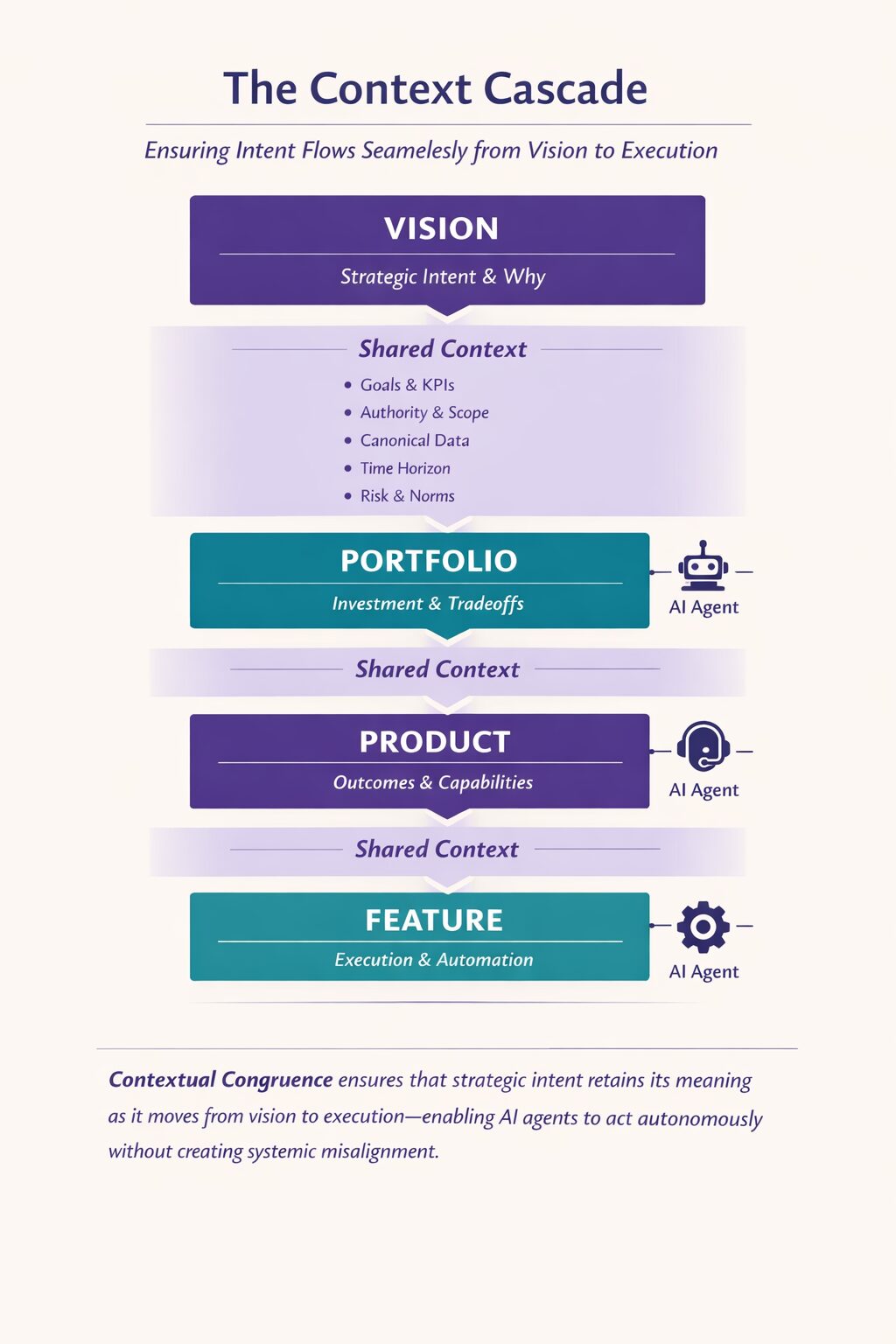
Contextual congruence is the degree to which intent, meaning, and decision logic remain consistent as they flow through an organization’s hierarchy.
In a product context that means:
Vision → Portfolio → Product → Feature
When contextual congruence is strong, every layer interprets upstream intent in a way that is locally appropriate yet globally consistent.
When it breaks down, AI systems, especially autonomous or semi-autonomous agents, begin to optimize in ways that are technically correct but strategically misaligned.
Why This Matters More With AI Than Traditional Software
Traditional systems are rigid. They do exactly what they are told even when that instruction is flawed.
AI agents are different.
They interpret, infer, and fill gaps.
This makes them a powerful double-edged sword, especially in environments where context is ambiguous, fragmented, or contradictory.
Without contextual congruence:
- Agents optimize local KPIs at the expense of global outcomes
- Portfolio priorities drift away from strategic intent
- Product decisions conflict rather than compound
- Feature-level automation creates inconsistent customer experiences
In short: AI amplifies whatever structure already exists including misalignment.
Contextual Drift Across the Hierarchy
Let’s look at where things commonly go wrong.
Vision Level
At the top, vision is often aspirational:
- “Be customer-first”
- “Move faster than competitors”
- “Reduce operational risk”
If this intent isn’t translated into explicit tradeoffs, AI agents are left to guess.
Portfolio Level
Portfolio decisions convert vision into investment themes and priorities.
Without contextual congruence:
- Speed is prioritized without guardrails
- Cost reduction conflicts with experience quality
- Risk tolerance is assumed, not defined
AI systems begin optimizing for whichever signal is loudest.
Product Level
Products operationalize portfolio intent.
Here, ambiguity turns into:
- Conflicting roadmaps
- Misaligned success metrics
- Competing interpretations of “value”
AI-powered decision support can unintentionally reinforce these conflicts.
Feature Level
At the feature and workflow level, automation executes at scale.
If context has drifted by this point:
- Features behave inconsistently across journeys
- Exceptions multiply
- Humans step back in to “fix” AI outcomes
The result is automation that increases friction rather than leverage.
Context Is the Control Plane for AI
Many organizations attempt to fix these issues with:
- More prompts
- More rules
- More oversight
But these are symptoms, not causes.
Contextual congruence acts as a control plane ensuring that autonomy emerges safely because intent is preserved, not because behavior is constrained.
When agents share:
- The same goals
- The same definitions of success
- The same understanding of authority, time, and risk
Coordination emerges naturally.
Designing for Contextual Congruence
Achieving contextual congruence requires deliberate design, not accidental alignment.
At Jadeed, we help organizations:
- Make strategic intent machine-interpretable
- Map context throughout the product heirarchy
- Identify where semantic drift occurs and suggest changes in direction towards ‘congruence’
- Establish communication during contextual conflicts for mitigation and possible reprioritization
The outcome isn’t just better AI performance.
It’s product and organizational coherence.
Each phase of the product journey is assisted by our agents that help you define, align and execute your product vision maintaining contextual congruence.
The Takeaway
AI doesn’t fail because it lacks intelligence.
It fails because it lacks shared understanding.
With Jadeed you gain a partner that helps you maintain persistence of vision throughout your product roadmap.
Leave a Reply